The Zaidín office expands its hours with two afternoons and continues the information meetings to claim earthquake damages
The service adds afternoon assistance while the Consortium already has 12,531 claims and €35 million in damages


The Information and Advice Office set up at the Zaidín Civic Center continues to assist residents affected by the seismic series and is extending its availability this week. In addition to the usual schedule from Monday to Friday, from 10:00 a.m. to 1:00 p.m., two extra afternoon shifts are being added: Wednesday 26 and Thursday 27, from 5:00 p.m. to 8:00 p.m. Added to this are the group information meetings, which are held on Mondays at 7:00 p.m. and Fridays at 12:30 p.m.
The service, promoted by the Granada City Council in collaboration with the Bar Association (ICAGR), is free of charge and was installed in Zaidín because it was one of the districts that concentrated the highest number of review requests from the first days. Mayor Marifrán Carazo has placed this in-person assistance among the priorities of the municipal operation: "Information is essential at this moment with the Zaidín office, whose hours we have expanded."
What can be resolved there
The inquiries that arrive at the counter are repeated. "What they are mainly asking for is information about home insurance and how to handle the paperwork related to it," explains lawyer Juan Carlos Guerra, who works at the office.
The advice focuses on three specific fronts: the obligation to report the incident, how to document the damage, and how to contact the body that will take on the payment. "They are provided with all the information related to the need to report the incident, to document the damage suffered, to gather the information and the way to access and contact the Insurance Compensation Consortium, which is the entity that will ultimately be responsible for the compensation," the lawyer explains.
The requirement that determines whether there is compensation or not
The earthquake is legally considered an extraordinary risk, so there is no need to take out a specific policy. However, the Consortium does not respond simply because the damage was caused by an earthquake: it is essential to have a regular insurance policy in force on the affected property —home, community, premises, office, industrial property, or vehicle— and to be up to date on payment of the premium and the corresponding surcharge.
Coverage is adjusted to the scope of that private policy, with its insured sums and its split between building and contents. The assessment is carried out by the Consortium independently of the insurance company, and double compensation for the same damage is not possible.
As for deadlines, the Insurance Contract Act generally sets seven days from the moment the incident becomes known to report it, although the Consortium has confirmed that it will also register and process claims submitted outside that period, provided coverage existed at the time of the damage. The claim can be made directly by calling 900 222 665, on the organization’s website, or through the insurer, agent, or broker.
Professionals in the sector insist on one detail that can condition the entire process: photograph and record every piece of damage before cleaning, clearing debris, or repairing, and keep invoices, estimates, and the remains of damaged items available to the assessor.
No structural damage in the buildings inspected
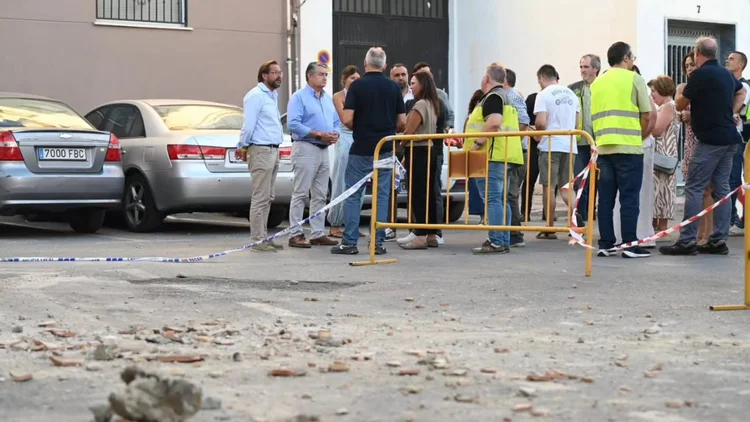
The municipal operation continues working through the accumulated requests. Carazo explained that the Local Police, Firefighters, and the Urban Planning and Maintenance services remain deployed to deal with the 291 calls that were left pending from a previous day of inspections.
The balance of those assessments matches that of the first days. "In all these assessments, as already happened with the earthquake on the 15th, we have not detected any structural damage in our buildings," the mayor said, attributing that behavior to the regulations applied in the city: "The fact that there is no structural damage in the buildings shows the robustness of our buildings, of the homes, and of that technical code that is stronger than in other cities, precisely because we are in a seismic zone."
The damage detected is concentrated in cracks and fissures in homes and buildings, which are being reviewed in coordination with volunteers from the Surveyors and Architects associations. The mayor has acknowledged the residents’ state of mind —"I understand that we are all nervous, frightened, worried"— and has called for following the official channels of the City Council, the Local Police, Civil Protection, and 112, as well as consulting self-protection measures.
The return to normality is progressing in parallel with the inspections, with debris-clearing work and the reopening of streets that were closed to traffic during the period of greatest seismic activity.
The scale of the episode
The seismic series began on August 14 and experts describe it as a swarm, a succession of shallow earthquakes of similar strength that can last for weeks. Among the most intense episodes are the earthquake with a magnitude close to 5 on August 15, with its epicenter in the Alhendín area, and another of 4.8 recorded on the 18th.
The volume of claims gives a measure of the material impact. The Consortium has received 12,531 compensation claims, with a provisional cost of the damage exceeding 35 million euros. Of these, 11,719 correspond to homes and homeowners' associations, more than 93% of the total, followed by 609 files for shops and warehouses, 152 for offices, 34 for industrial risks, and 17 for vehicles. The requests come from 74 municipalities in Granada, in addition to ten in Málaga and nine in Jaén.
Technical inspections point to damage concentrated in cladding, false ceilings, and partitions, with special attention to traditional buildings with load-bearing walls, which require a more detailed analysis.
In parallel, the City Council has approved a 95% reduction in the ICIO tax for works intended to repair damage to homes and commercial premises.